The Boilermaker
The Boilermaker was invented after owning a number of other popular brand name boiler temperature and power controllers commonly used in brewing and distillation. Every time I thought that I was buying just what I needed, I ended up being let down by shortcomings. Take my word for it, there are a lot of inflated promises used to sell these things that simply never add up.
This is one of those projects that I steered away from for years, even after numerous requests. I only moved forward with this after tearing a bunch of failed units apart to find out precisely what failed. The problem? Totally substandard cheap triacs (what most brewers and distillers call SCRs).
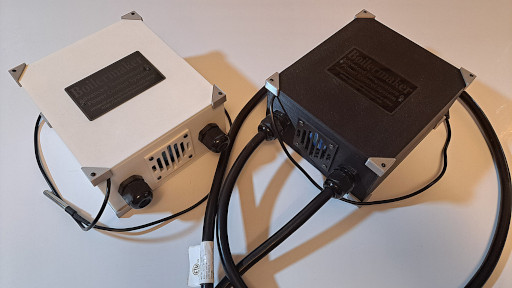
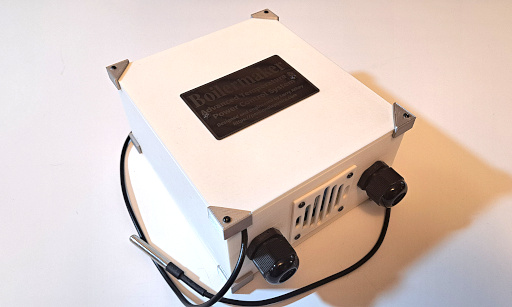
The Boilermaker was derived from the Airhead temperature and power controller, but with the addition of WiFi and a mobile-friendly web user interface. This also resulted in a full web API so the Boilermaker could be controlled by other devices over the same network such as the RPi Smart Still controller and about anything else that can make API calls.
On top of that, one Boilermaker can use API calls to control four more slave Boilermakers. Each of those slaves can also control four more slaves. So if you have a professional grade 100+ gallon still with four 4500 watt elements in it, four Boilermakers can handle the job perfectly fine. It runs on 120 volts or 240 volts and handles 5500 watts with ease. (No bogus 10,000 watt claim)
As with the Airhead, the Boilermaker features multiple operating modes. Constant Power, Temperature Cruise (PI mode), Brewing Fermentation (PID mode), and Cruise Then Brew. The last mode automatically transitions from PI to PID mode after the target temperature has been reached. It also features timed and progressive temperature modes.
The same slow speed pulse width modulator and solid state relay power controller used in the Airhead is also used here as well. Heating elements run far more efficiently and effectively than they do when a triac chops up the AC power with phase angle distortion. This is actually better for your heating elements and helps prevent premature heating element failure.
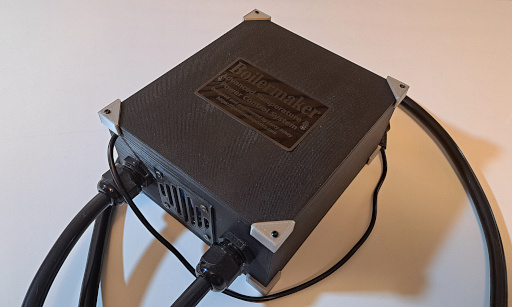
The μBoilermaker is actually the guts of the Airhead in a smaller Boilermaker style case and is specifically designed for 120 volt resistive loads up to 1500 watts. However, it will also work on 240 volts if you want to change out the plugs on the 10 amp pigtails. Just keep in mind that these cables are only rated for 10 amps.
This version is not WiFi enabled and uses the same touch screen navigation as the Airhead. It runs in PID mode by default but can be switched back to PI mode with the press of a button. This version is more than capable of running things like an electric meat smoker, Digiboil, Still Spirits boiler, etc. It just doesn’t require a WiFi connection like the full size Boilermaker.
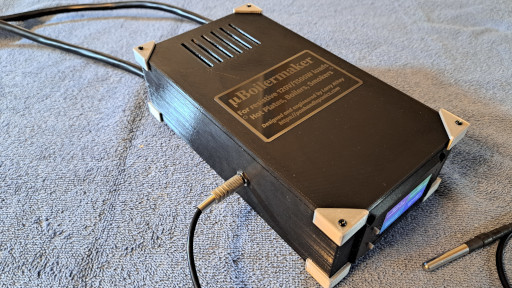
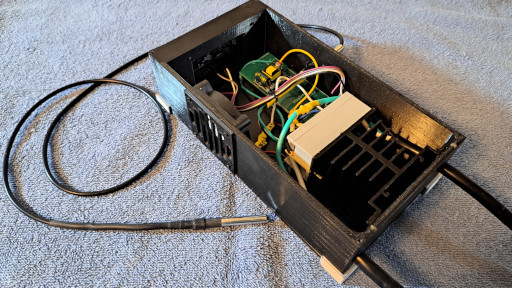
The μBoilermaker was created by request from people who use Vevor stovetop stills with an electric hot plate and Vevor’s other electric stills with a temperature dial. In both cases, you just crank the dial wide open and let this device control the power instead. The only modification to the still is the installation of a thermowell mid-height in the boiler for the temperature sensor.
If you are using one to run an electric smoker, you will still need to install a thermowell half-height in the smoking chamber for the temperature sensor. I personally use one to run the cheapest Masterbuilt smoker they make and it now performs as well as their top of the line models for a fraction of the price.
Additional Product Notes
Since all cases are 3D printed, you have your choice of Black or White, this will be confirmed after the order is received. Other colors may be available upon request, but will require an additional fee and delay time to ship. Cases are 3D printed using PETG filament to make them heat resistant, without emitting the foul odor that comes along with ABS.
For those wanting to do a custom build with the Boilermaker brains inside of an existing device, a fully populated PCB is now available as a separate purchase. Includes ESP32 WROOM32 with built-in antenna, USB-C port, latest Boilermaker firmware, a MAX6675 amplifier and type-K thermocouple. Fully compatible with DS18B20 digital temperature sensors (not included). The Adafruit model 3846 is highly recommended due to its 9 foot cable and high temperature PTFE insulation. You provide your own SSR, industrial or consumer grade.
Ordering Information
Boilermaker (hard wired) : $155 + USPS Ground Advantage Shipping
Boilermaker (w/pigtails) : $175 + USPS Ground Advantage Shipping
Boilermaker PCB-only : $85 + USPS Ground Advantage Shipping
Micro Boilermaker : $165 + USPS Ground Advantage Shipping
Refer to the GitHub page for further instructions, to report any and all bugs, and to make suggestions for future enhancements.
Open Source Declaration
I have made this product an open source project on GitHub since day one. This includes all source code, diagrams, and 3D models.
You are more than welcome to build your own from scratch, make a fork of the project and improve upon it, anything you wish up to and including selling your own version. Simply honor the GPL.